
What is a private label makhana manufacturer?
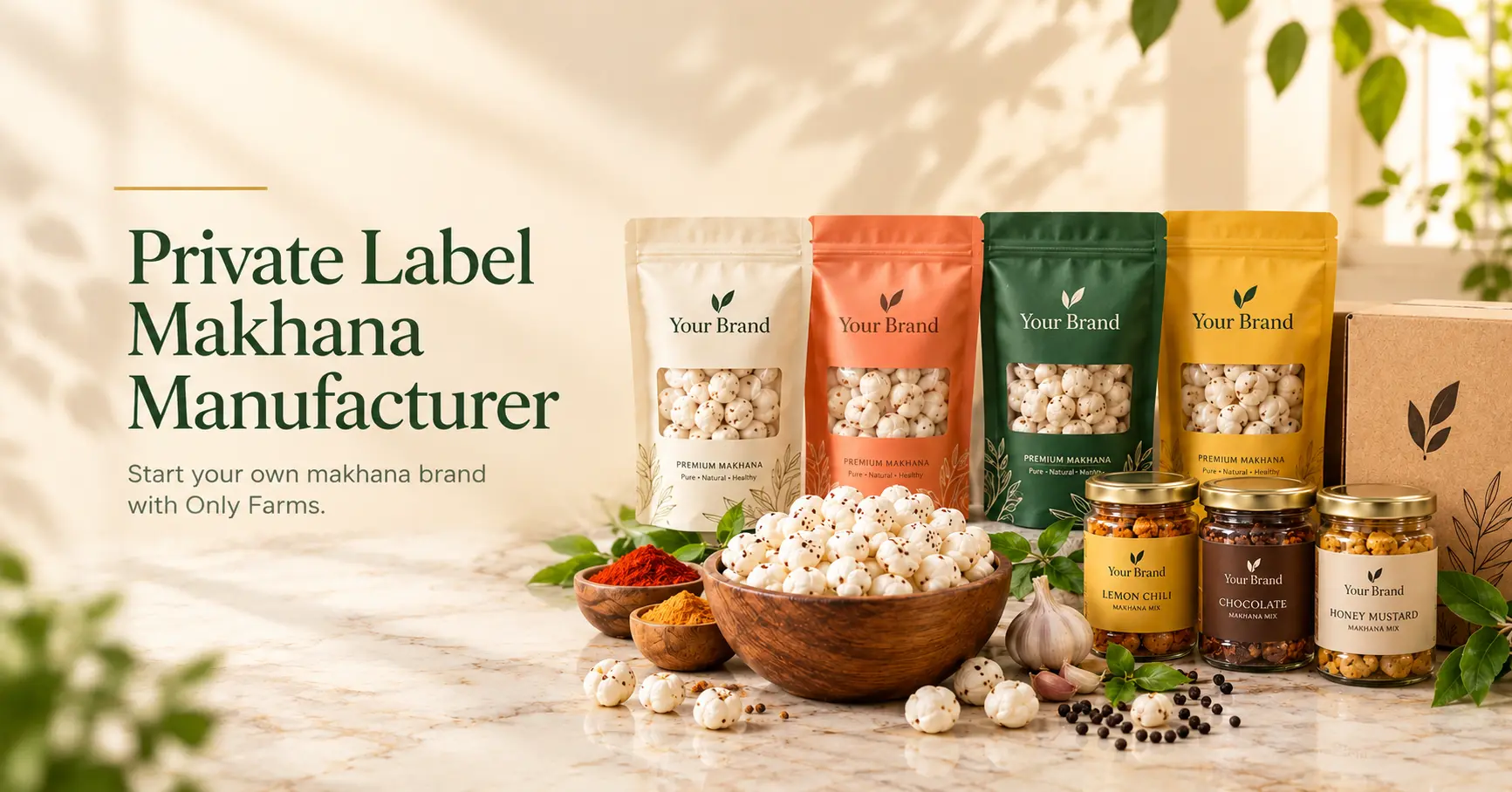
A private label makhana manufacturer is a company that sources, processes, flavours and packs makhana (fox nuts or lotus seeds) in bulk, then sells it under your brand name instead of its own. You bring the brand, the design and the customers. The manufacturer handles the farm sourcing, popping, roasting, seasoning, quality testing and packaging.
In short: you get a ready-to-sell makhana product without owning a single processing unit.
At Only Farms, this is exactly what we do. We work with new D2C founders, grocery chains, gifting companies, cafes, gyms and exporters who want a healthy snack brand of their own, and we take care of everything between the pond and the pouch.
Why makhana is one of the smartest private label bets right now
Ten years ago, makhana was mostly a fasting-day food in Indian homes. Today it sits in the “better-for-you snacking” aisle next to protein bars and baked chips, and the reasons are easy to see:
- Naturally light and clean. Makhana is low in fat, gluten-free and made from a single ingredient.
- A protein and fibre story that customers understand. Health-conscious buyers are actively looking for alternatives to fried namkeen.
- Flavour flexibility. It takes peri peri, cheese, pudina, cream and onion, and sweet profiles like caramel equally well.
- Strong repeat purchase. Snacks get finished and reordered, which is what every brand owner wants.
- Global demand. Indian superfoods are travelling well, and makhana is a standout.
Most of the world’s makhana is grown in Bihar, especially the Mithila region, which has a GI tag for Mithila Makhana. Working with a manufacturer connected to these growing belts matters, because raw material quality decides everything that follows.
What does a good private label makhana manufacturer actually do for you?
A reliable partner covers the full chain, not just the packing:
- Raw material sourcing: direct relationships with farmers and aggregators, so the seed quality stays consistent season after season.
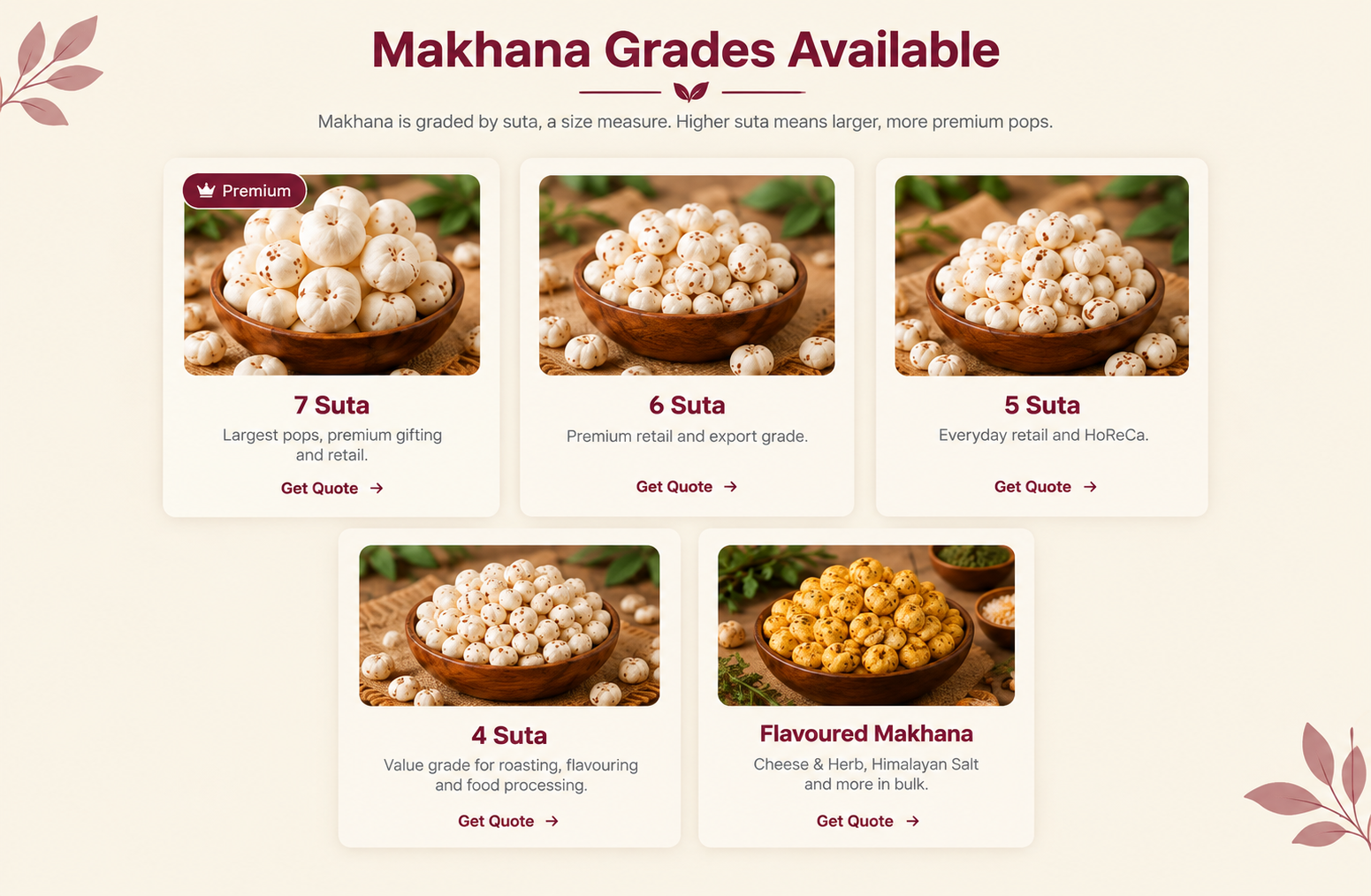
- Grading and sorting: makhana is graded by size (commonly 3 suta, 4 suta, 5 suta and above). Bigger, whiter pops cost more and look better on shelf.
- Popping and cleaning: removing husk, dust and discoloured pieces.
- Roasting and flavouring: dry roasting or light ghee/oil roasting, followed by seasoning that sticks evenly.
- Moisture control: this is the secret to crunch. Makhana that holds moisture turns chewy within days.
- Packaging: zip-lock pouches, stand-up pouches or tubs, ideally nitrogen-flushed for freshness.
- Labelling and compliance: FSSAI-compliant labels, batch codes, nutrition panels and barcodes.
- Quality testing: lab checks for moisture, microbial load and aflatoxin.
Private label vs. white label makhana: is there a difference?
People use the terms interchangeably, but there is a small distinction worth knowing.
- White label: you pick from an existing, ready-made product, and your label goes on it. It is faster and cheaper, with less customisation.
- Private label: the product is made to your specification: your flavour profile, your pack size, your packaging design, sometimes your exclusive recipe.
Only Farms supports both. If you want to test the market quickly, start with white label. If you are building a long-term brand, move to a fully custom private label range.
Popular private label makhana flavours and formats
What sells depends on your audience, but these are the evergreen options:
- Lightly salted / plain roasted
- Peri peri
- Cream and onion
- Cheese
- Pudina (mint)
- Tangy tomato
- Himalayan pink salt and black pepper
- Caramel and jaggery-based sweet makhana
- Chocolate-coated makhana
- Plain raw makhana for cooking, kheer and fasting
Pack formats: 25 g trial packs, 50 g single-serve pouches, 100 g and 250 g retail pouches, 500 g and 1 kg value packs, and bulk bags for repacking.
How to choose the right private label makhana manufacturer (a practical checklist)
Before you sign with anyone, ask these questions. A genuine manufacturer will answer them without hesitation.
1. Are they properly licensed and certified?
Look for an FSSAI licence at minimum. For larger retail or export work, certifications such as HACCP, ISO 22000 or FSSC 22000, and an APEDA registration for exports, add real confidence.
2. Can they show you their popping and grading quality?
Ask for samples across sizes. Check for uniform colour, minimal broken pieces and a clean, neutral smell.
3. What is their shelf life and how do they achieve it?
Properly processed and packed makhana typically stays crisp for around 6 to 9 months. Ask about moisture levels and whether nitrogen flushing is used.
4. What is the minimum order quantity (MOQ)?
Some manufacturers only serve huge buyers. Look for one whose MOQ fits a growing brand, so you are not forced to over-invest in inventory.
5. Can they customise flavours?
A partner who can tweak spice levels, sweetness and ingredients to your taste is worth far more than one who hands you a fixed catalogue.
6. Do they help with packaging and design?
Label regulations are strict. Having a team that knows what must appear on pack saves you costly reprints.
7. How transparent are they about pricing and timelines?
Get clear quotes that separate raw material, processing, flavouring and packaging costs. Ask about lead times, especially around festive seasons when demand jumps.
8. Do they send pre-dispatch samples and batch reports?
This single habit separates serious manufacturers from casual ones.
How the private label process works with Only Farms
We keep it simple, because launching a brand is stressful enough.
Step 1: Tell us your idea. Share your target customer, budget range, flavour preferences and pack sizes. Even a rough idea is fine.
Step 2: Get samples. We send sample packs so you can taste, test texture and judge quality before committing.
Step 3: Finalise your specification. We lock the grade, flavour, packaging type, label content and order quantity together.
Step 4: Packaging and label approval. You share your artwork, or we guide you on compliant layouts.
Step 5: Production and quality checks. Your batch is processed, flavoured, tested and packed under controlled conditions.
Step 6: Dispatch. Your finished, labelled stock reaches your warehouse or your customer, anywhere in India or overseas.
We are happy to answer questions at every stage. You will always talk to a real person who knows your order.
Why brands choose Only Farms as their private label makhana partner
We are a farm-first company, and that shapes how we work.
- Closer to the source: better control over quality and consistency of raw makhana.
- Honest quality standards: we would rather reject a batch than ship something that hurts your brand.
- Flexible customisation: flavours, grades and packs built around your plan, not ours.
- Founder-friendly approach: we support small and growing brands, not only large orders.
- Clear communication: no vague promises, just specific timelines and prices.
Your brand’s reputation sits on every pouch you sell. We treat it that way.
Who is private label makhana right for?
- D2C and Amazon/Flipkart sellers starting a healthy snack brand
- Supermarkets and grocery chains adding an in-house range
- Gym, fitness and wellness brands expanding into snacks
- Corporate gifting and festive hamper companies
- Cafes, hotels and restaurants
- Exporters serving Indian and health-food markets abroad
Common mistakes to avoid when starting a makhana brand
- Choosing only on price. The cheapest makhana is often the least crunchy, the most broken, or poorly stored.
- Skipping samples. Always taste before you commit.
- Ignoring shelf life. Soft, stale makhana kills repeat purchases.
- Launching too many flavours at once. Start with three or four strong ones and expand once you see what sells.
- Overlooking label compliance. Incorrect labels can block your listing or your shipment.
Frequently asked questions
What is the MOQ for private label makhana?
It varies by manufacturer, flavour and packaging type. At Only Farms, we aim to keep MOQs workable for growing brands. Contact us with your requirement for an exact figure.
Can I get my own custom flavour made?
Yes. A good private label makhana manufacturer can develop or adjust flavours to match your brand. Share your reference taste and we will work from there.
How long does makhana stay fresh?
With correct roasting, moisture control and airtight, preferably nitrogen-flushed packaging, roasted makhana usually stays fresh for about 6 to 9 months.
Is makhana healthy?
Makhana is a light, gluten-free snack that is low in fat and made from a single natural ingredient. Its nutritional value depends on how it is roasted and flavoured,
